
3 poems by Stephen Leggett
1 essay by Sally Rosen Kindred, on the poems of Stephen Leggett
“The Little Doors…Open”: Poems as Improbable Worlds
Long ago, here on earth, at the turn of the century, after lunch and before his nap, my son would watch a DVD of the Mir Space Station. He could stand now, point and choose: each day, he chose this video. He was a small person with vivid eyes–with words, light and milk--who’d arrived here from across an unfathomable distance: adopted internationally, he’d flown here from a country whose bright green birds I’d never heard or seen. I’d watch him, this person wholly new to me–my son–watching astronauts float across rooms to each other in zero gravity, and wonder. How had we come this far, to be alive together here? These three poems took me back to that feeling (ghostly, improbable, luminescent) of crossing thresholds of air. Of hearing green ghost birds singing.
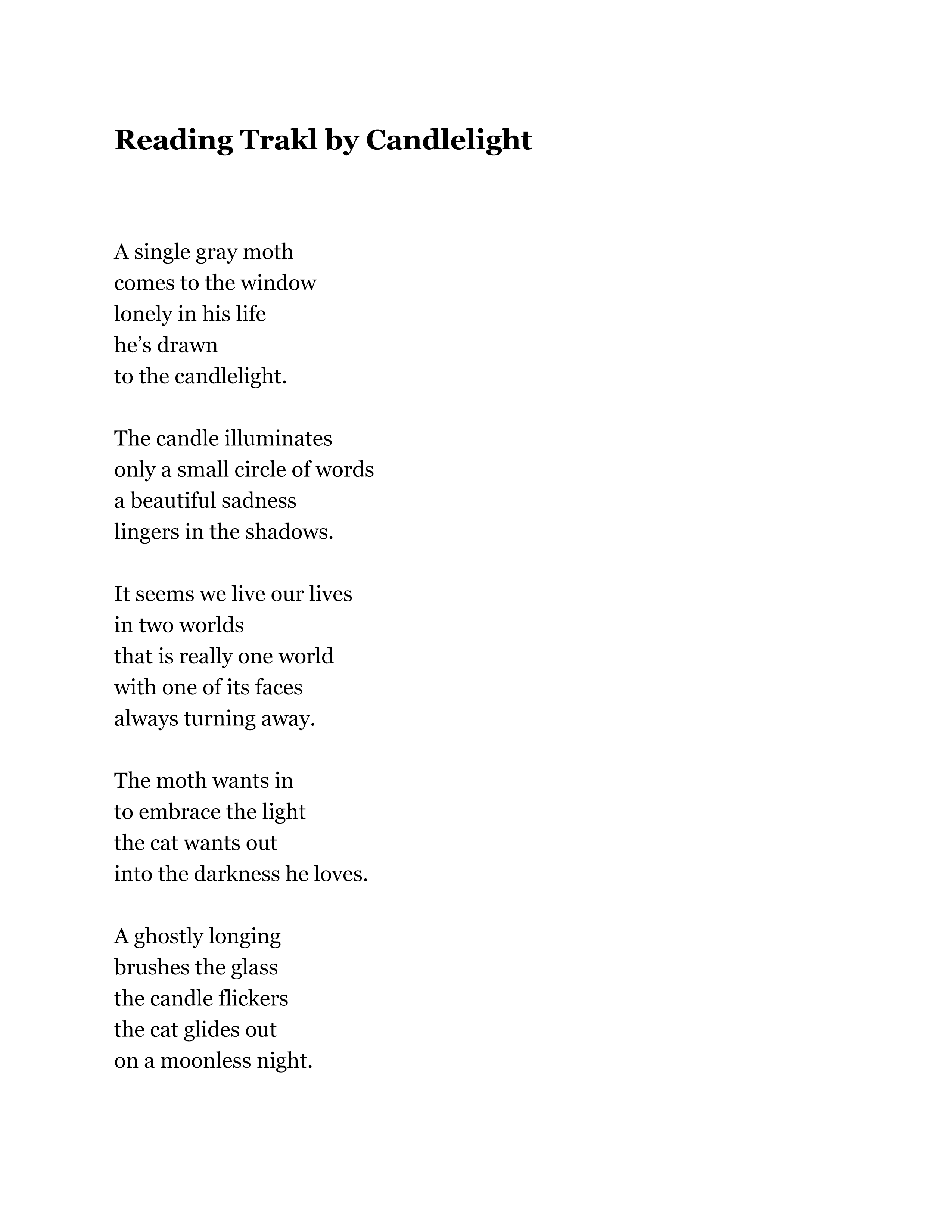
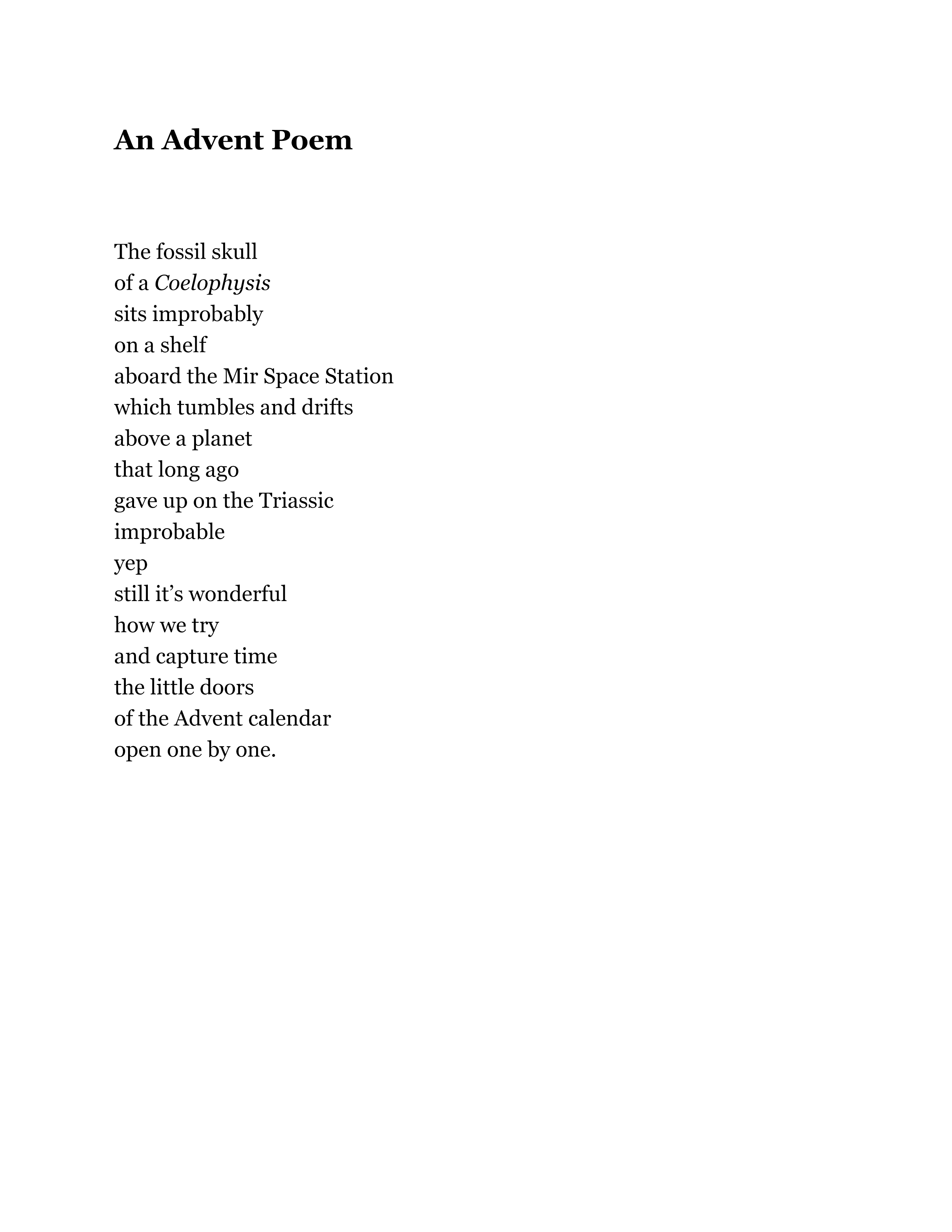
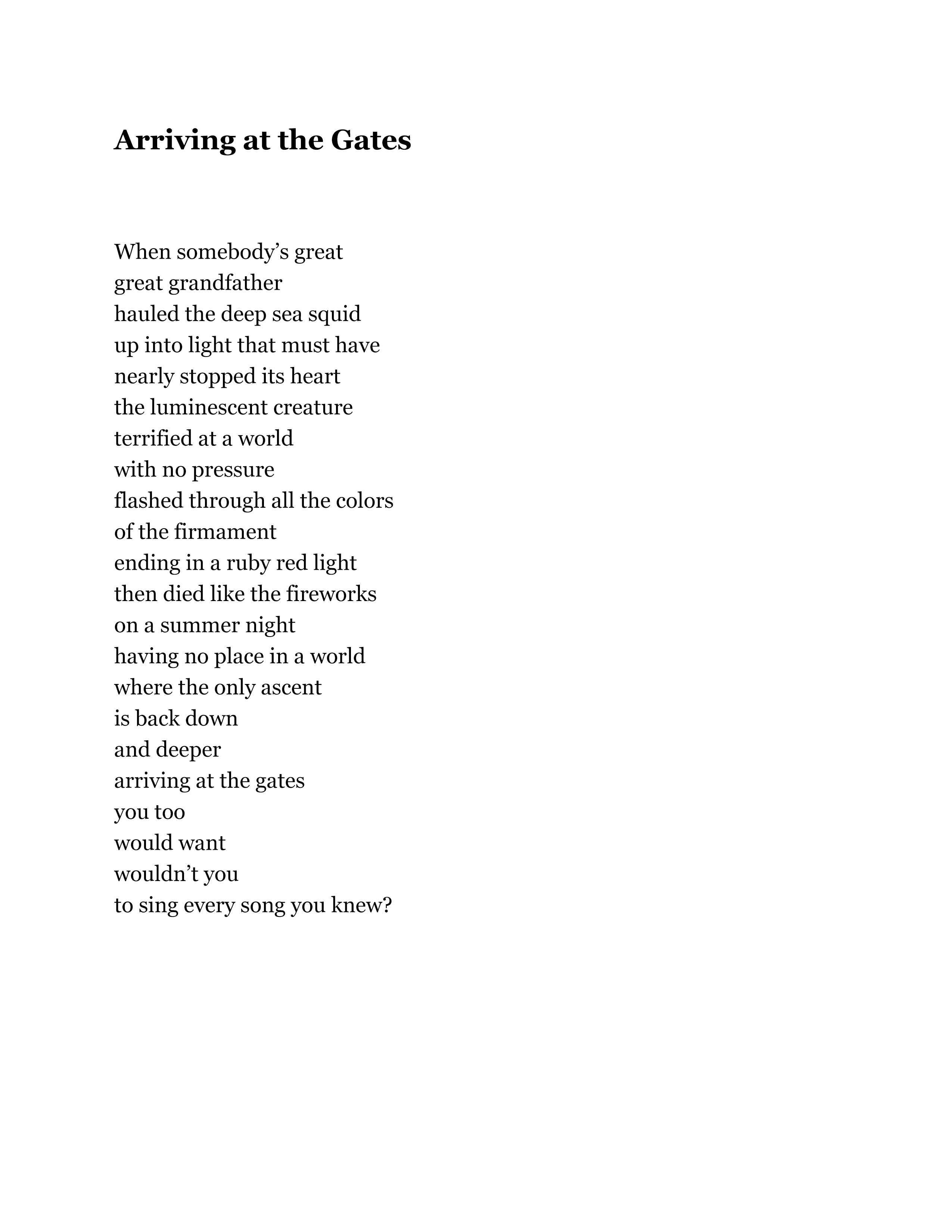
These poems reveal borders, liminal spaces. They sing of how living beings belong to and cross them–what borders might mean to their existences. In “Reading Trakl By Candlelight,” the border is the window, where “a ghostly longing/ brushes the glass”–or is it the candlelight, holding “a small circle of words” inside, as “sadness/ lingers” without? (Or is the border the poem itself, the words a light the moth wants to enter, the cat wants to leave?) In “An Advent Poem,” the threshold is time and space, as “the fossil skull…sits improbably…aboard the Mir”–one earthling’s past body crossing into another’s future, left to “tumble and drift” over the place where it once walked, ate, died. (Oh, the wonder of what the living ones have done.) “Arriving at the Gates” offers a door between water and air, a border of breath, which the deep sea squid must cross–unlike the Coelophysis–while it’s alive. “Hauled…/ up into light.” Terrified. Singing.
I love how these poems work with scale–the way they suggest how far, how long existence is, and the universe. Little doors. They do this through an enigmatic, and convincingly multi-dimensional, brevity. Containment. No long line, not even one as wide as the page, could embody the vastness of space and time–because the edge of the page (that you could hold in your hand!) would always signify the limits of our own small bodies, our lives. Perhaps only the restraint of narrow lines and tight stanzas could give up mere mimesis and gesture, otherwise, toward mystery. These poems are, like the vehicle of Time-Lord Dr. Who, bigger–much bigger–on the inside.
Instead of using line and stanza length to represent untellable realms, these poems go dark and deep, finding mystery in figurative vision. They signify the expanses they cross through images that speak to wonder…and horror. They invoke the wildness of loneliness, longing, choice–and lack of choice, violence. There’s beauty in the “ghostly longing” that “brushes the glass,” the way the living want in and out of the candlelight. There’s wonder in the impulse to “capture time” in an image that holds life’s distant past and its bewildering (improbable) future. And: there’s horror in the human impulse to do what can be done with this power–to another, to the squid–to haul it across an unfathomed border, an act which “must have/nearly stopped its heart.” Beauty in the eye of a human, to witness as it “flashed through all the colors,”–but whose brute choice is it, for it to “sing every song [it] knew”?
Ghostly. Improbable. Sing[ing]. Capture. Time. Space. Terrified. Light. These words, floating across the rooms of these poems, arriving at the gates, are singing from the liminal, like birds in the green ghost trees. Every song we know.