
3 poems by Shannon K. Winston
1 essay by Cal Freeman, on the poems of Shannon K. Winston
A+R
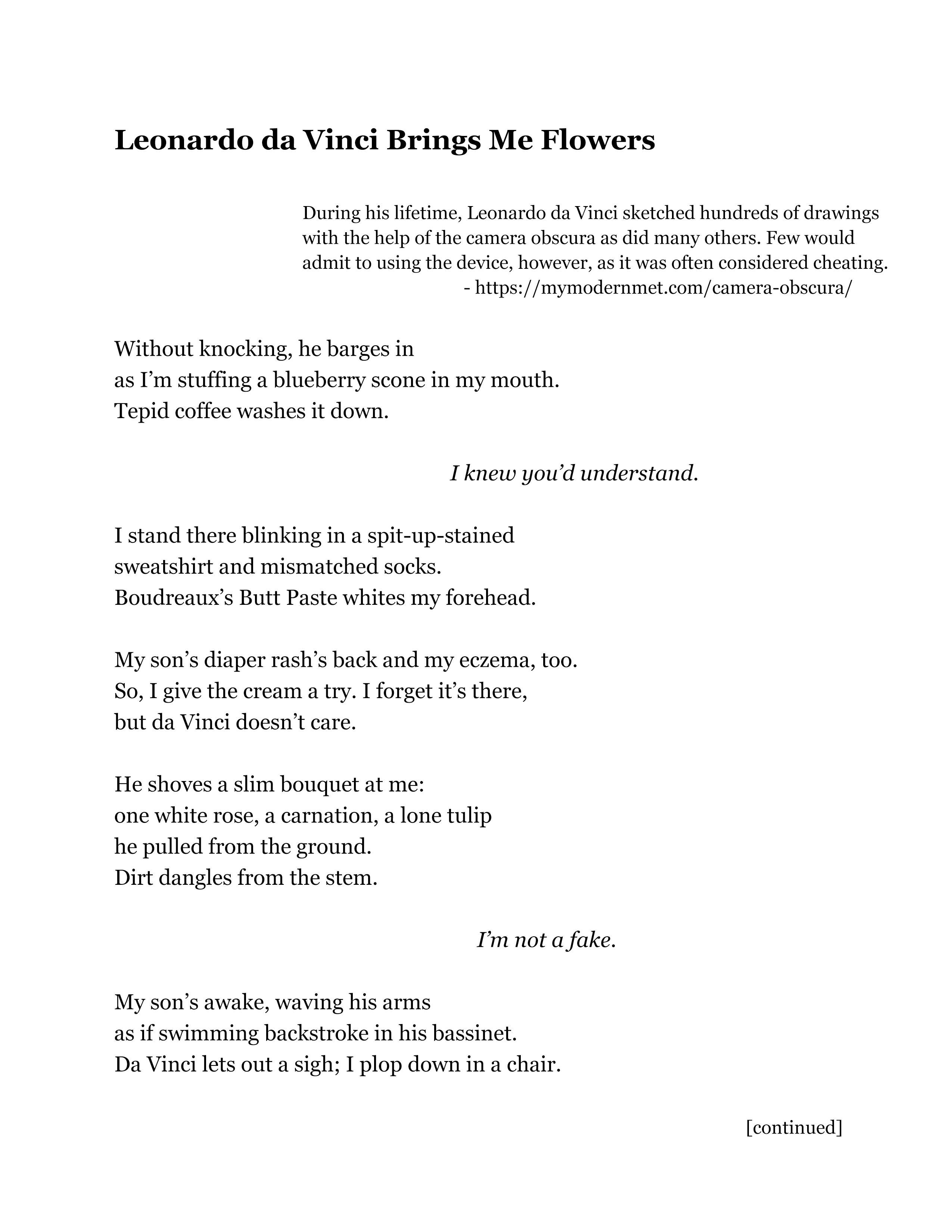
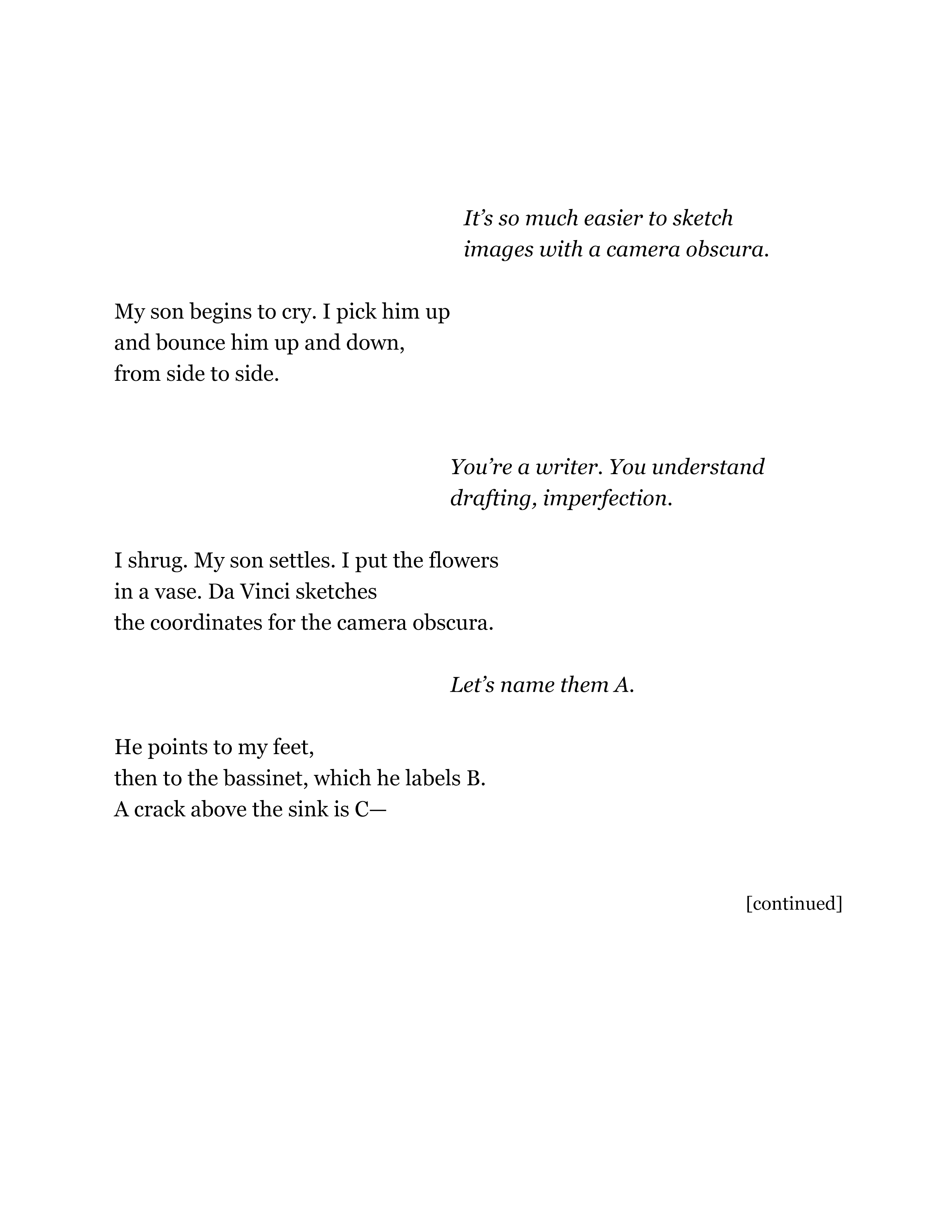
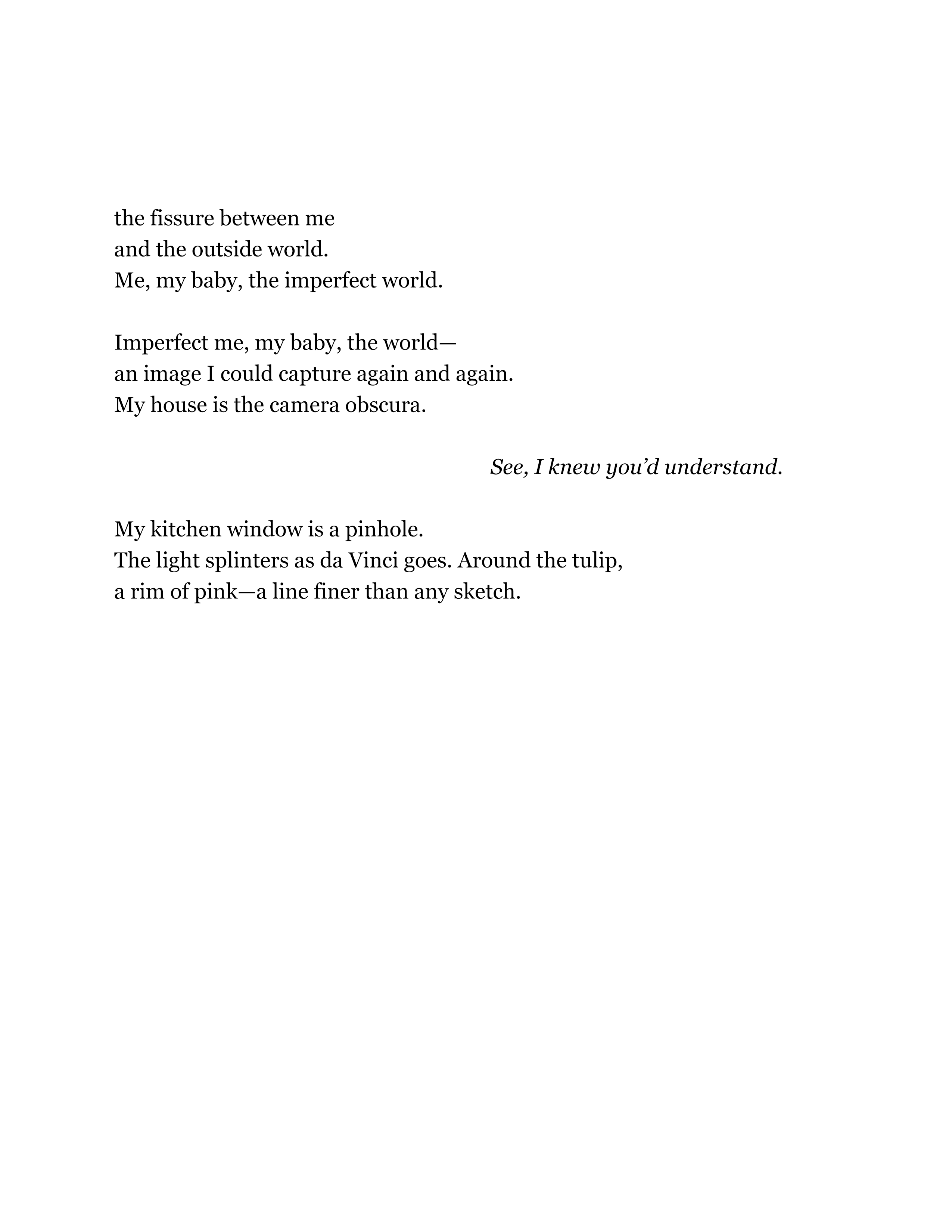
“Leonardo da Vinci Brings Me Flowers” is the kind of anachrony we all on some level desire: a hauntological visitation by a historic figure. He’s here in the quotidian kitchen, finding a kindred spirit in the 21st century poet. I knew you’d understand, he tells the poet who is washing down a blueberry scone with tepid coffee. Who is parenting and doesn’t have much time for da Vinci’s histrionics, but he’s got one white rose, a carnation, a lone tulip / he pulled from the ground. / Dirt dangles from the stem. Da Vinci is a bit sheepish concerning his use of the camera obscura to draft sketches. Our speaker is unphased by da Vinci’s plight but finds the anxiety surrounding originality and agency productive nonetheless. You’re a writer. You understand / drafting, imperfection, da Vinci says.
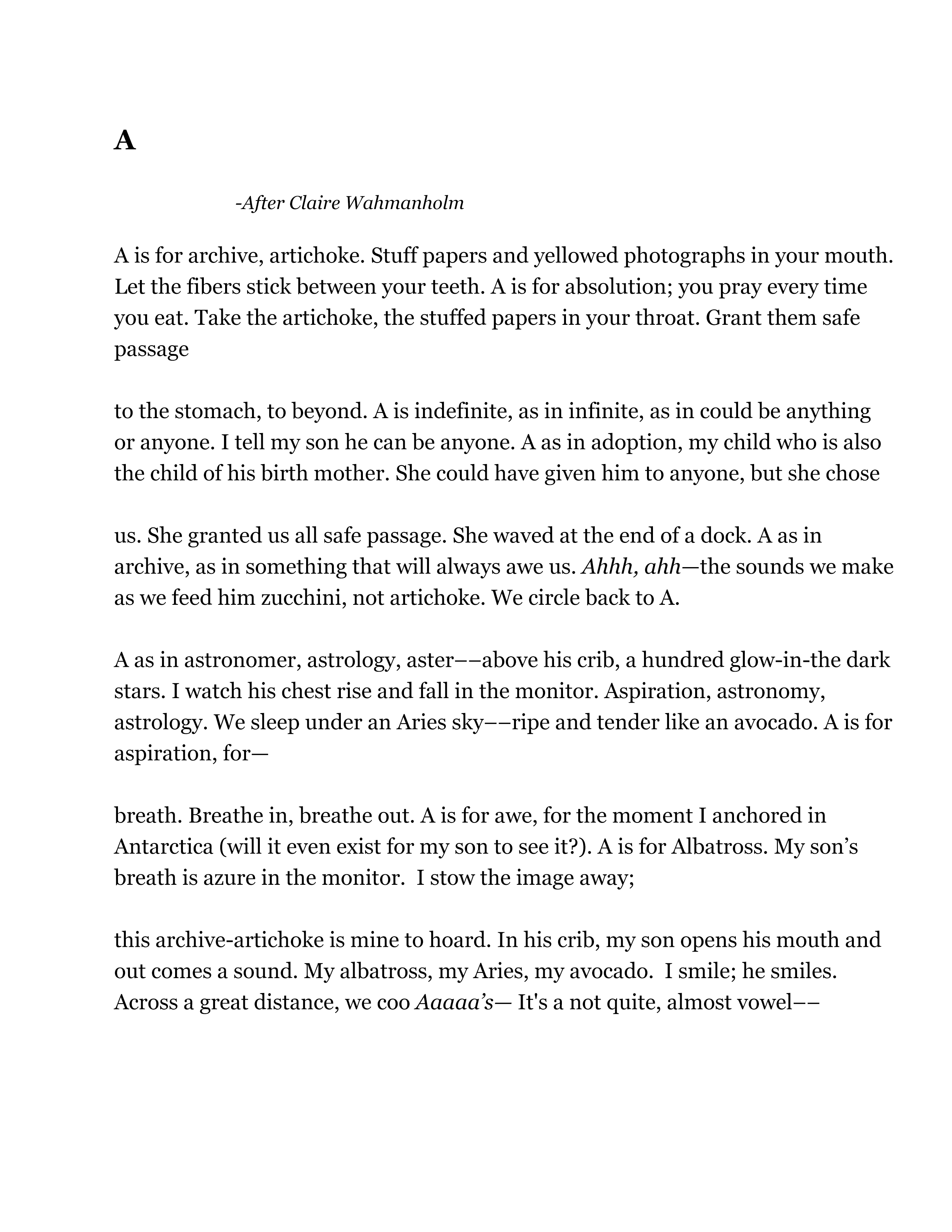
Poems “A” and “R” carry the intertextuality between artists into the present, engaging with the poetics of Claire Wahmanholm, a contemporary poet. At a glance these seem like dictionary poems, but upon further reading they are stories about coming into speech. In all three poems the speaker’s son is present as a companion and a teacher. One of the staggering concepts underpinning these lyrics is the idea that allowing our young to teach us is an essential mode of nurture. The speaker is an adoptive mother, we learn in “A.” A as in adoption, my child who is also the child of his birth mother. She could have given him to anyone, but she gave him to us. To nurture is to learn, while to observe diligently is a kind of love. Part of parenting, for our poet, is to babble away without worrying whether the Aaaaa’s—it’s a not quite, almost vowel—will cohere. They surely will.
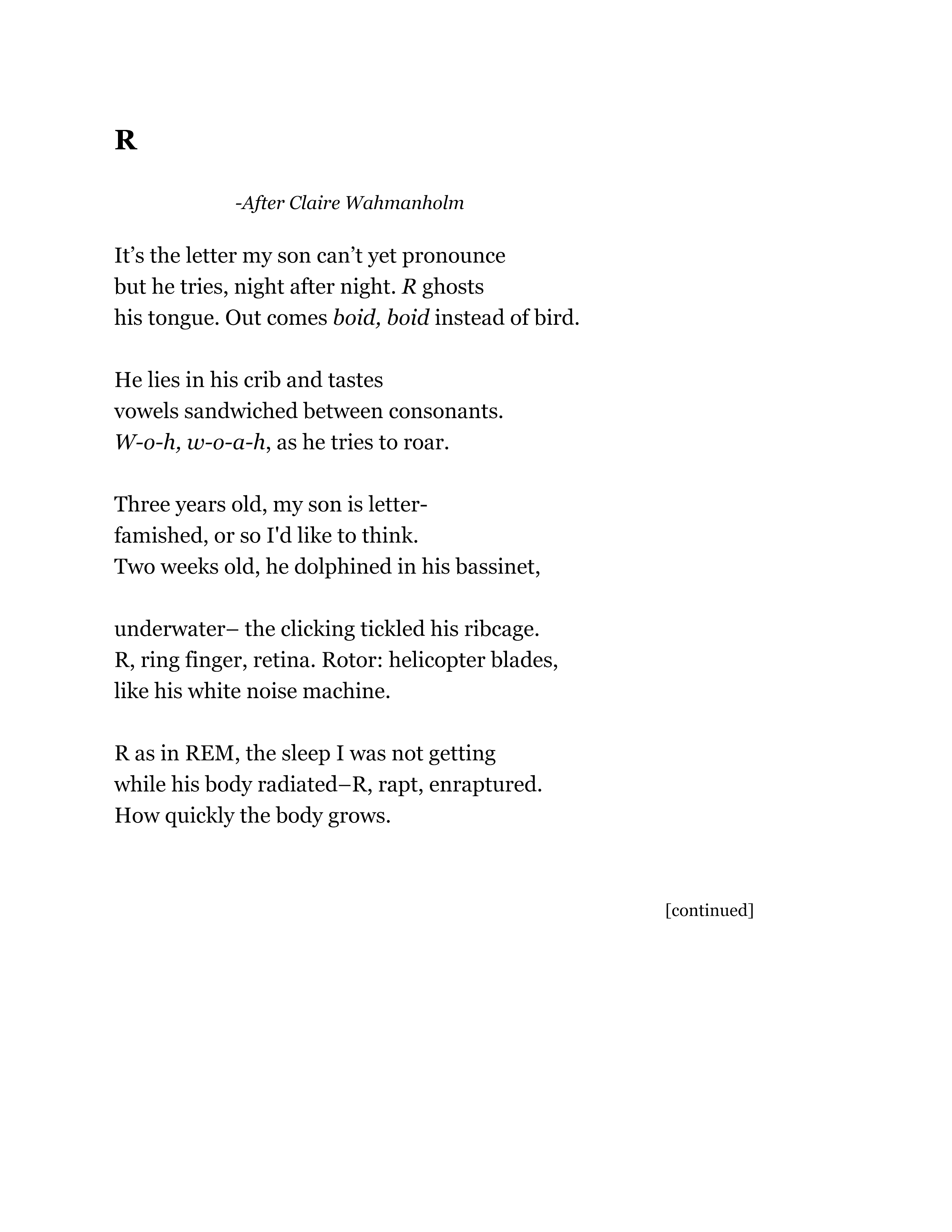
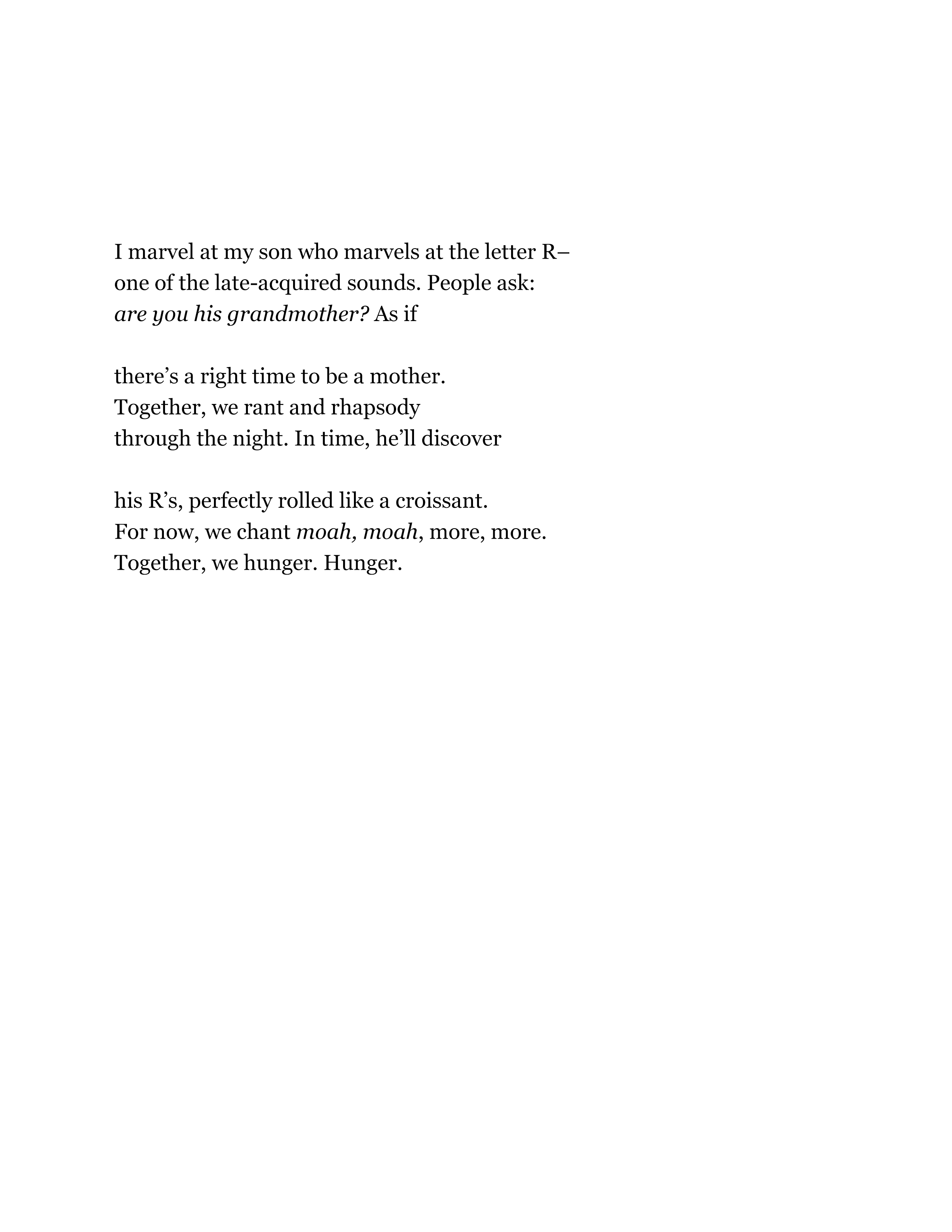
“R” is a thrilling name for a poem for its evocation of Paul Klee’s “Villa R” and its homage to a wonderful letter in the alphabet. The R has a sound phenomenological and architectural structure to it—the two sturdy legs centering the ringed post near the top of the letter. The R, the capital R anyway, has load-bearing i-beams that instill trust in the reader when we encounter such a title. There’s something nebulous about speech when the r sound is absent, our poet explains—It’s the letter my son can’t yet pronounce… Out comes boid, boid instead of bird. “A” is a prose poem, but “R” is set in tercets, and the consonant slant rhyme functions like a vestigial terza rima. It’s unnecessary to correctly pronounce your Rs. The form will dredge up those sounds in the mind of the reader.
Our speaker is too busy mirthfully sharing language with her son as He lies in his crib and tastes / vowel sandwiches between consonants. / W-o-h, w-o-a-h, as he tries to roar to let the slurred R sounds trouble her. The son is Two weeks old.. dolphined in his bassinet. “Dolphined” is such a lovely solecism. The poem lands on the word “hunger,” which word lands on the letter R, and how appropriate. For what is poetry but hunger for the fictive and the real at once, the mirror stage and the immediacy of the pure immersion that precedes it? In our infancy we are perfecting our mistakes. In our parentage we are sloughing off what we used to know. Together, we rant and rhapsody / through the night.