
3 poems by Sean Thomas Dougherty
1 essay by Katie Hartsock, on the poems of Sean Thomas Dougherty
1. In a sestina, each teleuton mirrors itself in the previous stanza, thereby showing in itself gradation, change, progression. The mirror image “rhymes” itself, but is not “itself.”[1]
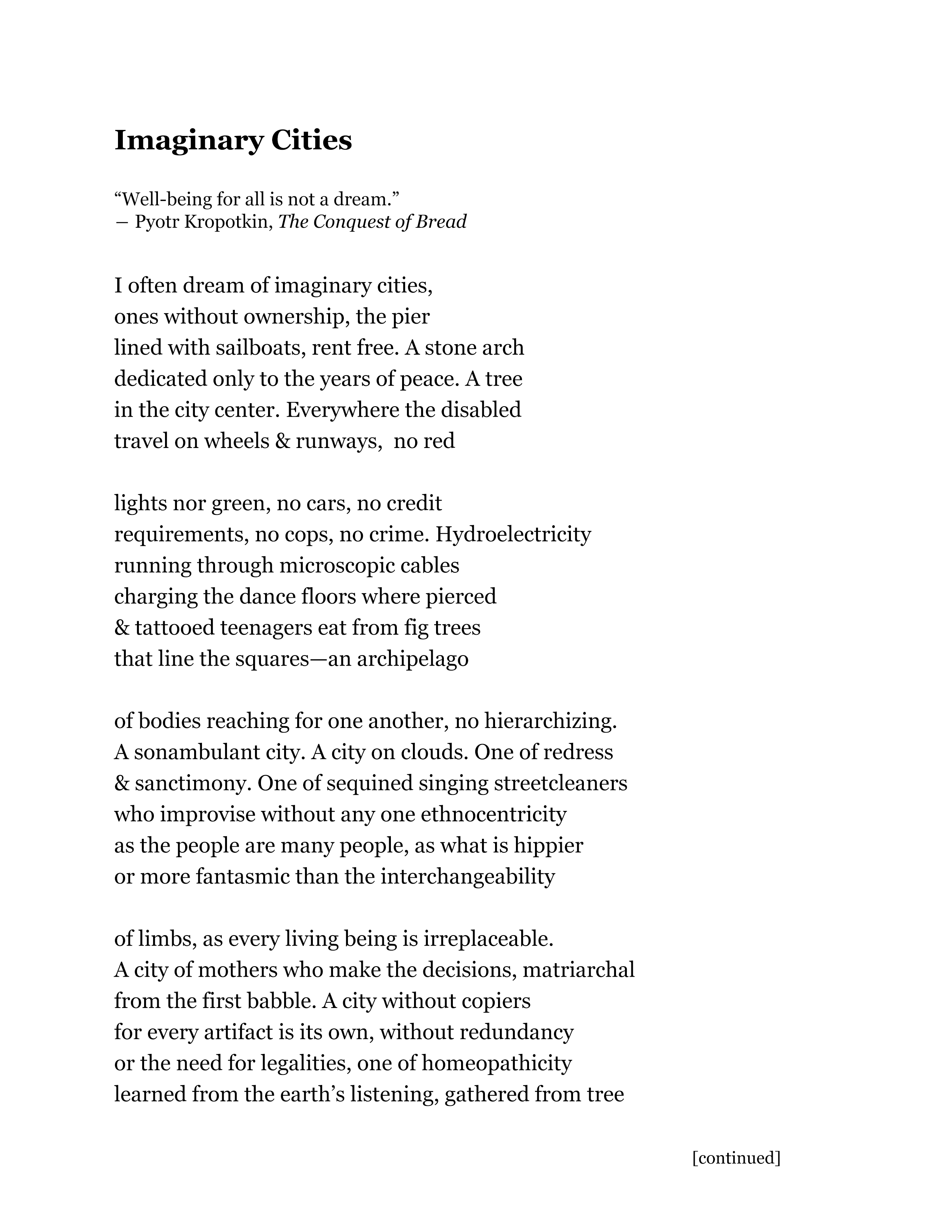
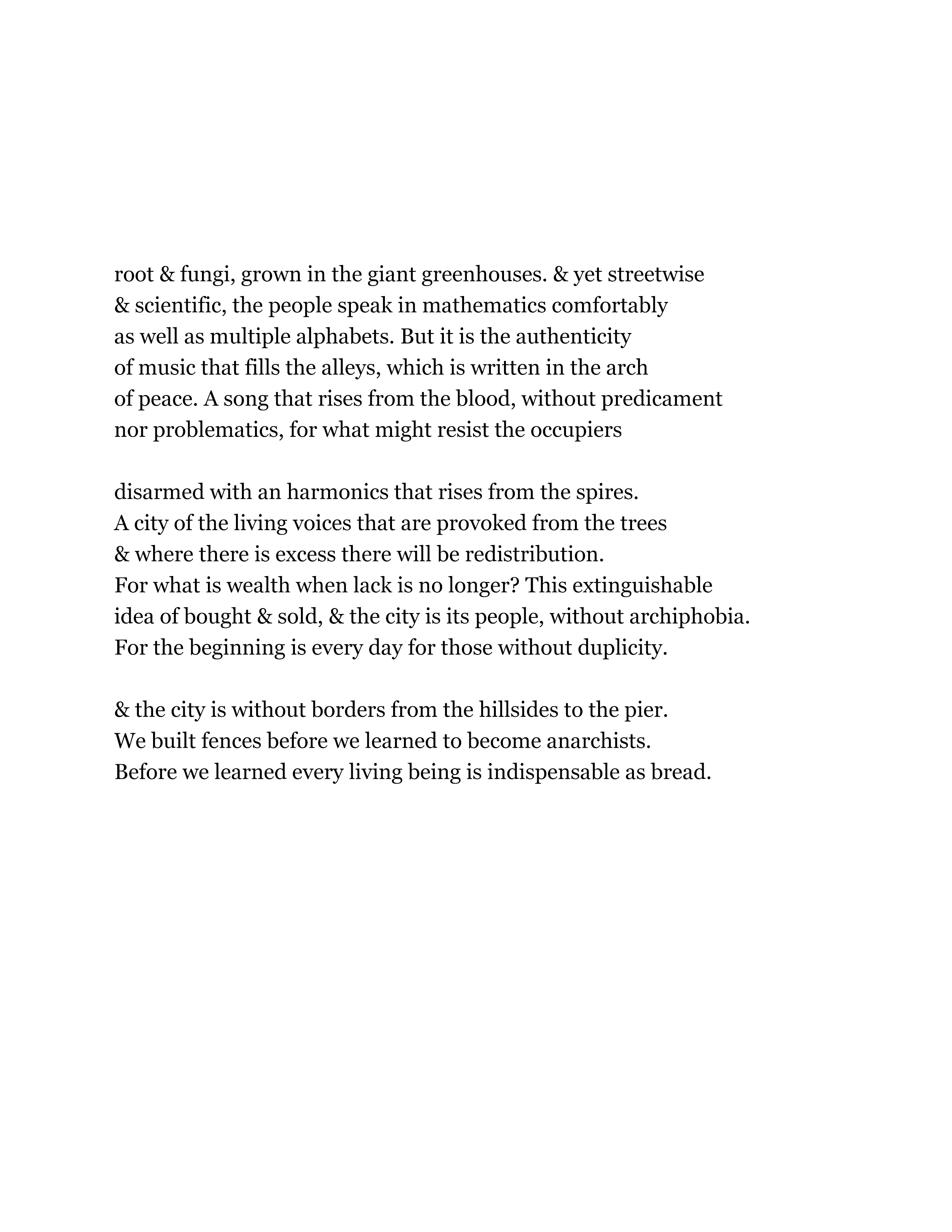
When I first read “Imaginary Cities,” I thought sestina (perhaps the visual six-seven of stanzas: the rich six and the slender seventh), but had not strongly sensed repetition; when I went back to track the teleutons, I was dazzled. City becomes both authenticity and duplicity: a contradictory and true mirror. Pier extends into copiers, hippier, occupiers, spires. Red appears in the overdue bills of credit, in the remedy of redress, in the formally meta mention of redundancy (which good repetition eludes).
2. The rhyme words appear in an ordered sequence whose repetition . . . corresponds to the transmutation of one element into another . . . . The poem is itself born of these transformations . . . .[2]
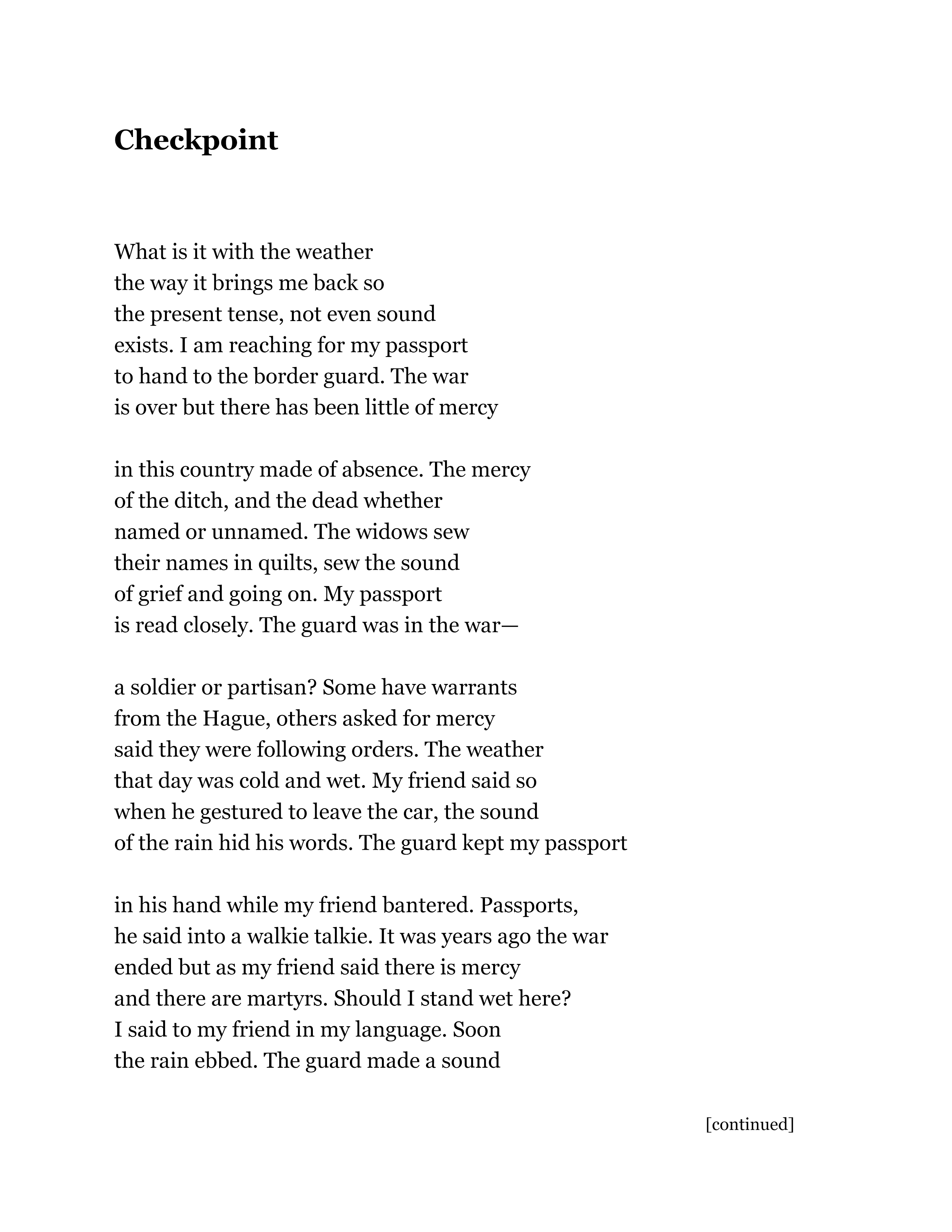
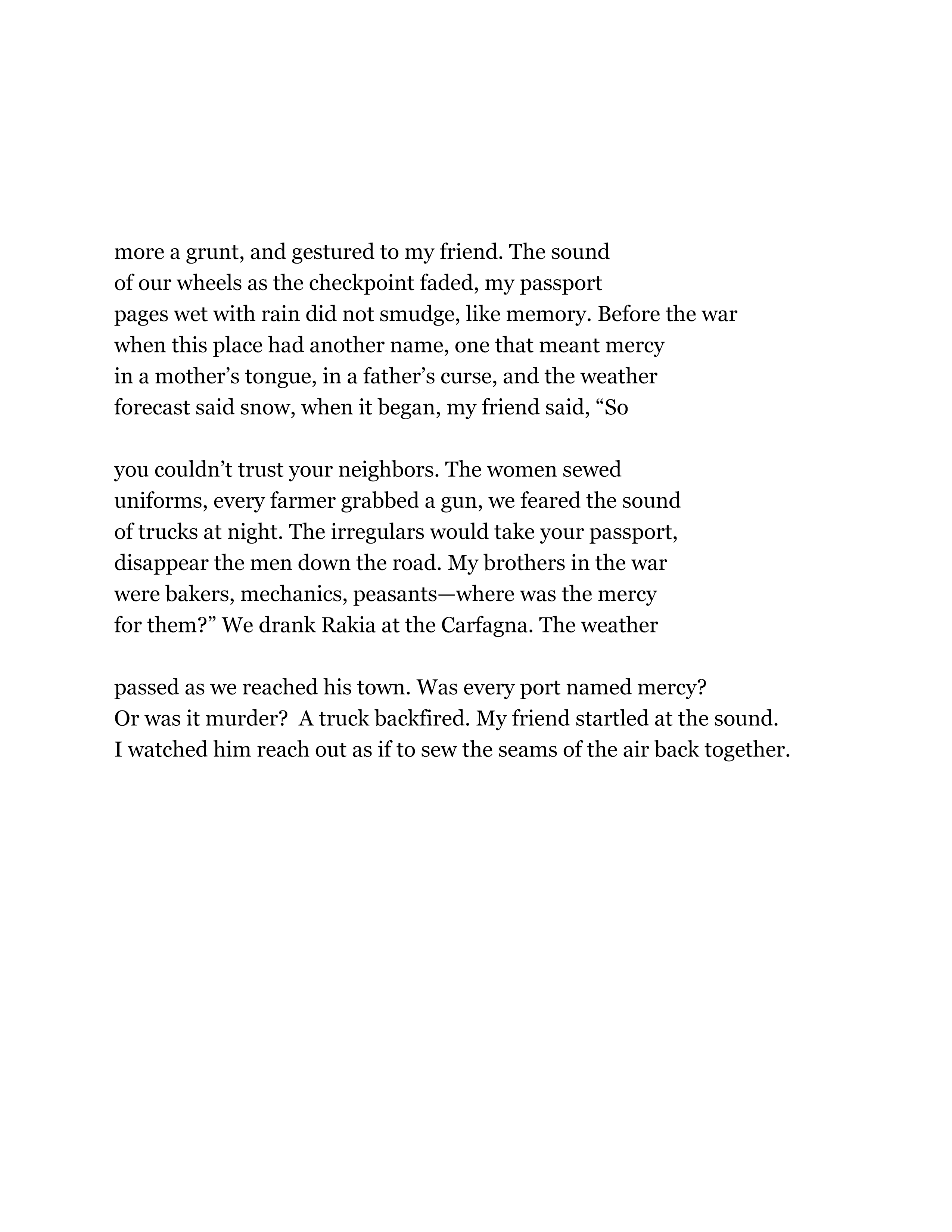
Gottlieb’s comments on Auden’s “Canzone” (another form employing teleutons in intricate repetition) echo “Checkpoint.” Changing through its form, it describes a nerve-wracking border crossing and imbues its surroundings with the aftermathematics of war, betrayal, deaths innumerable. The repetition of “passport” advances the narrative; in the hinge repetition from the third to fourth stanzas, a guard holds the speaker’s passport while intoning “Passports” into his walkie-talkie, as the bureaucratic transforms, teleutonically, from merely routine to de-humanizing and dangerous. This also lets us wonder what a passport is. Identity, history, a kind of record, as kept or “disappeared” as its person.
3. The formal principle of a sestina has nothing to do with metrics; it has everything to do with whether you can get said what you thought you wanted to say, as you find out what it is you can say.[3]
Cummins’ description of the gift of any form resonates in the exquisite envoi (the voyage out) of “Checkpoint,” especially its questions that were, perhaps, made possible (given) by teleutons: “Was every port named mercy? / Or was it murder?” And, in the final words and thoughts of “Imaginary Cities,” which contain able and red: “every living being is indispensable as bread.”
4. Formal repetition promises a future, bringing that which escapes the will into the ordered course of events . . . . Auden’s “Canzone” . . . analyzes the zone of this possibility, this can-zone.[4]
The war haunting “Checkpoint” echoes many wars, timely and heart-breakingly timeless. A sentence like “We drank Rakia at the Carfagna” spirals us into the knowable and unknowable. It leaves a taste in our mouth. It contains no teleutons but was propelled and shaped by their returns. Like Auden’s “Canzone,” these sestinas form spaces of possibility: “can-zones.”
5. . . . you engage form, you don’t choose it. It isn’t an arrow in your quiver; it’s an arrow in you, and it quivers; it’s a kind of love.[5]
Engaging, poets depart from form. I cannot find teleuton 4, “tree,” in the envoi of “Imaginary Cities”; does it want to send me out looking for trees? Or is absence its end’s anarchy? And in the envoi of “Checkpoint,” where are war and weather? Is war in murder, or backfired? Is whether in together, or in the “or” nature of those questions? The mirrors and rhymes of teleuton 2, so (first enjambed such that it could be adverb or result clause; it also appears in the temporal promise of soon), guide us: we must sew these missing teleutons back into our reading. So that we too can take part in the poem’s form, its becoming, its kinds of love.
___________________
[1] Cummins, James. “Calliope Music: Notes on the Sestina.” The Antioch Review, Spring, 1997, Vol. 55, No. 2, Poetry Now (Spring, 1997), pp.148-159. p. 156.
[2] Gottlieb, Susannah Young-Ah. “Reflection on the Right to Will: Auden's ‘Canzone’ and Arendt's Notes on Willing.” Comparative Literature, Vol. 53, No. 2 (Spring, 2001), pp. 131-150. p. 133.
[3]Cummins, p. 152. First two emphases mine.
[4]Gottlieb, p. 134.
[5] Cummins, p. 152.