
3 poems by Sarah Carson
1 essay by Stephen Leggett, on the poems of Sarah Carson
Paths to the River
There are a thousand paths to the river. We all have the paths and poems we prefer. For me, a poem begins as a landscape, as a backdrop for the thoughts and emotions the poem is balancing, a place where those thoughts and emotions can play out within a frame, like a painting, and like a painting, it continuously changes depending on the play of light and where one stands in the room that holds it. I’ve always admired poets like Wang Wei, Li Po, and Tu Fu who set their poems against a landscape of rivers and mountains and the sharp precision of the seasons, giving the poems a sort of timelessness that backdrops the human emotions of joy, grief, love, loss, and the reunions and partings that the poems address.
But there are a thousand paths to the river. The landscape of the poem doesn’t have to be all mountains and rivers. It can be a street, a room, a passing view out of a car window, but for me, I need some kind of a landscape to enter the poem, something that allows me to place myself within it, that locates me, that grounds me so I can marvel at the play of light across the words.
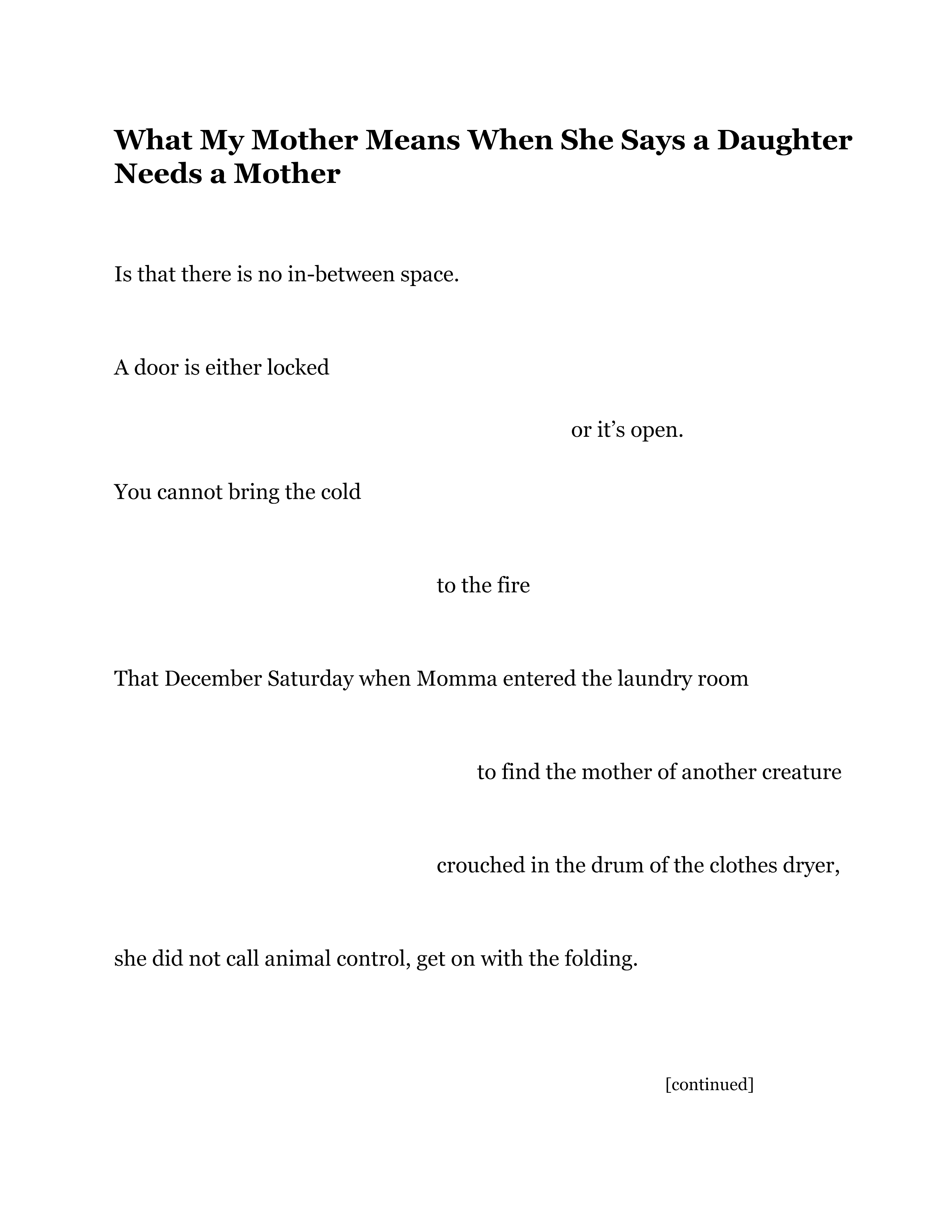
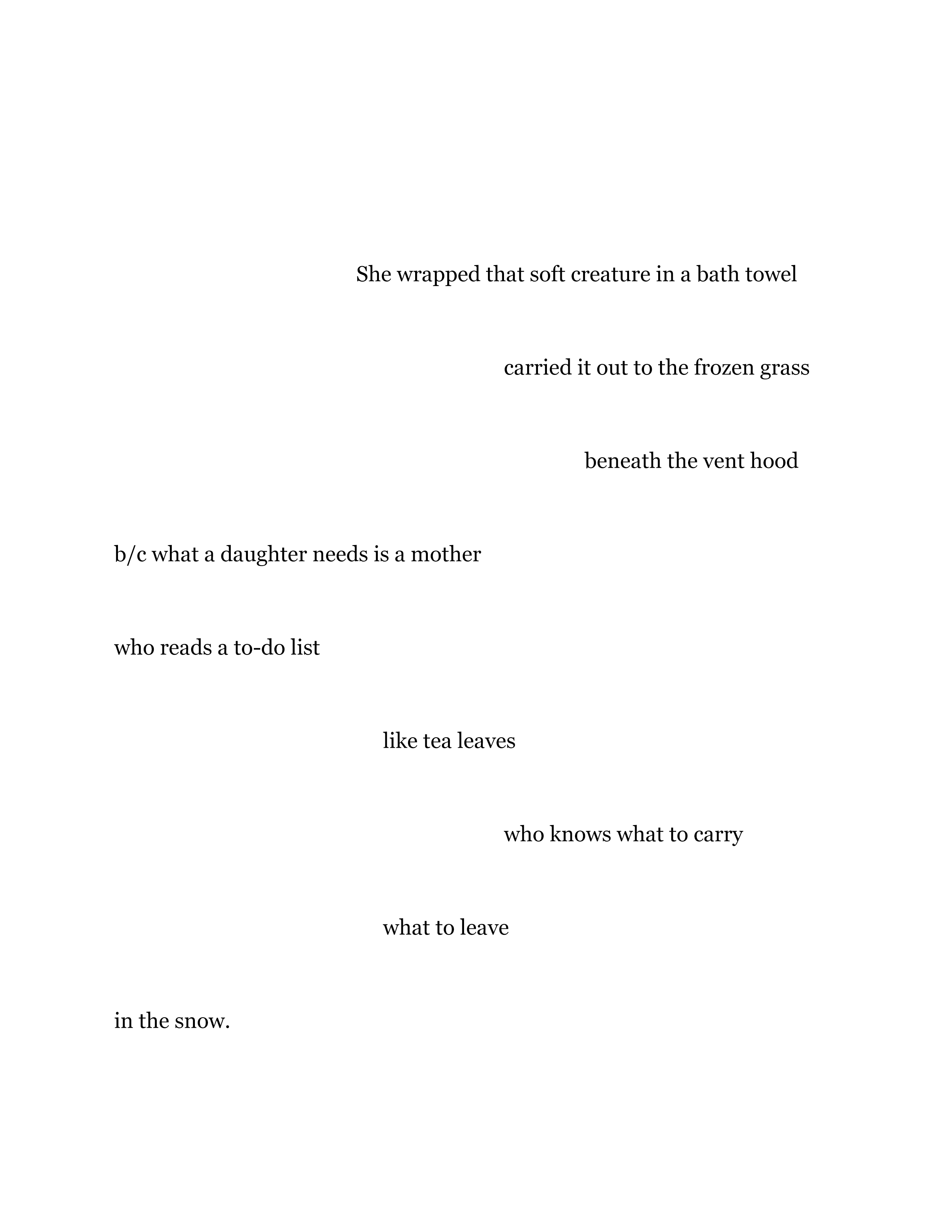
The only poem of the three I was given that allowed me to enter a landscape was ‘What My Mother Means When She Says a Daughter Needs a Mother.’ Here the landscape was familiar to me, a laundry room and a snowy yard. Both settings conjured up childhood memories. We had a laundry room in our basement, and growing up in northern Michigan, I certainly remember snowy yards. These two places backdrop the poem as it unfolds.
A mother finds a creature (never identified or named, but it’s also a mother) in the clothes dryer and carries it outside wrapped up in a towel and leaves it in a snowy yard. There’s a feeling of exhaustion in the poem (maybe that’s a memory I have of my own hard-working mother), but also a strange kind of affirmation, and it feels to me like a poem about love, about understanding misplacements and what to do about them, about the difference between where one is and where one ought to be, and who decides.
It’s a very mysterious poem for all its apparent clarity. I found myself wondering what kind of creature is better off in the snow in December than in a clothes dryer. Perhaps it’s a poem about freedom. It’s also a poem about mothers and daughters, how a daughter needs a mother, and that adds even more unsaid things into what this poem shelters. There are a thousand paths to the river. This poem gets there. It’s concise and open, and it gives me a landscape I can enter, even if I’m not sure what it is I need to find there. I keep thinking about it, finding new avenues of meaning, like opening a riddle and discovering it’s full of more riddles, and for me, that’s what a good poem does. It takes you to the river and leaves you on its banks to wonder.